
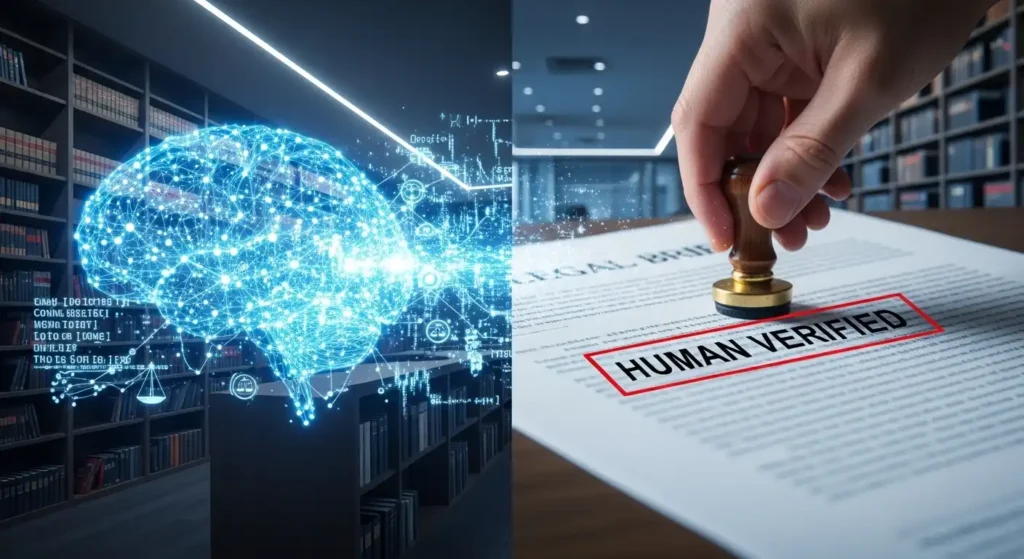
The Evolution of Rule 11: From Signature to Certification
 Historically, Federal Rule of Civil Procedure 11 (and its state counterparts) dictated that by signing a pleading or brief, an attorney certified that the legal contentions were warranted by existing law. In the pre-AI era, this was an implied trust. In 2026, that trust has become explicit and documented.
The “Verification Mandate” is a series of updated court rules that require a separate Certificate of AI Disclosure and Human Verification to be filed alongside any substantive brief. This certificate requires the signing attorney to swear, under penalty of sanctions, that every citation, quotation, and legal premise generated or refined by an AI tool has been manually cross-referenced against an official reporter or primary legal database.
Why 2026 is the Turning Point
You might ask: “Why now?” The shift in 2026 is driven by three major factors that have exhausted the patience of the judiciary:
- The Proliferation of “Deep-Fake” Precedents: Advanced AI models in late 2025 became so sophisticated that they didn’t just invent case names; they invented entire paragraphs of realistic-sounding judicial “opinions” that appeared to come from reputable judges.
- The “Good Faith” Defense Failure: Courts have grown weary of the “I didn’t know the AI could lie” defense. In 2026, judges are ruling that reliance on an unverified AI output constitutes a per se violation of the duty of competence.
- Judicial Efficiency: Law clerks are spending an estimated 30% more time “chasing ghosts”—looking for citations that don’t exist. The mandate is a gatekeeping mechanism to shift that labor back to the advocate.
Key Components of a 2026 Verification Certificate
While specific language varies by jurisdiction, most 2026 mandates require the following four disclosures in a brief’s front matter:
1. Disclosure of Tool Usage
Attorneys must identify which Large Language Model (LLM) or legal research platform was used to assist in the drafting. This includes both general-purpose AI (like GPT-5) and specialized legal tools.
2. The Verification Methodology
The mandate often requires a brief statement on how the verification was performed. Was it checked against Westlaw, LexisNexis, or a physical reporter? This “paper trail” is your primary defense against future sanctions.
3. Attestation of Fact-Checking
A specific clause stating that the attorney has personally read the cases cited to ensure they support the propositions for which they are offered. This targets the “out of context” hallucination where a real case is used to support a false premise.
4. Sanction Acknowledgment
A formal acknowledgment that the attorney understands that “AI error” is not a mitigating factor in the event of a Rule 11 violation. In 2026, the attorney is the AI’s supervisor, and the supervisor is strictly liable for the “subordinate’s” output.
The “Human-in-the-Loop” Workflow: Best Practices
To thrive under the new mandate, law firms must move away from “Prompt-and-Paste” and toward a “Human-in-the-Loop” (HITL) workflow. Here is a 2026-compliant checklist for every legal brief:
- Isolation: Keep AI-generated research in a “Drafting Sandbox” until every link and quote is verified. Never move content to the final pleading without a verification stamp.
- Primary Source Verification: Use AI to find the concept, but use an official government or licensed reporter to copy the text. AI-generated quotes are still prone to subtle “smoothing” that can change the legal meaning.
- The “Hallucination Trap” Test: Experienced 2026 litigators are now using a “Reverse Prompt” strategy—asking the AI to find cases that *contradict* its own findings. If the AI provides fake cases for the contradiction, it’s a signal that the entire research thread is compromised.
Case Law Warning: 2026 Sanctions in Practice
 Recent rulings in the Second and Ninth Circuits have set the tone. In Doe v. TechCorp (2026), a senior partner was fined $25,000 and referred to the state bar after a brief contained three “hallucinated” footnotes. The court held that even though the attorney had a “Verification Policy” in place, the failure of the associate to follow it did not shield the signing partner. The 2026 mandate emphasizes that delegation is not a defense.
Conclusion: Embracing the Responsible Future
The 2026 Verification Mandate might feel like a burden, but it is actually a stabilizer for the legal profession. It ensures that while we use the fastest tools ever created, we maintain the highest standards of accuracy that the justice system demands. At 25 Legal Briefs, we believe that the best briefs are a partnership between human judgment and technological speed. By mastering the verification process, you aren’t just complying with a court order—you’re proving your value as an indispensable, ethical advocate in an automated world.