

A high-stakes constitutional showdown is unfolding across the United States, placing state police powers in direct conflict with federal immigration authority. Dubbed the “No Secret Police” movement, a growing coalition of states—led by California, Washington, New York, and New Jersey—have enacted strict legislation prohibiting plainclothes or masked law enforcement officers from operating within their jurisdictions without clearly visible agency identification. While framed by state lawmakers as essential measures to protect public safety and preserve community trust, these statutes have triggered immediate, aggressive legal retaliation from the federal government.
The U.S. Department of Justice (DOJ), acting on behalf of Immigration and Customs Enforcement (ICE) and Customs and Border Protection (CBP), has launched a series of federal lawsuits to invalidate these state-level restrictions. With the U.S. Court of Appeals for the Ninth Circuit recently blocking key provisions of California’s landmark statute, the legal arena is now set for a definitive assessment of federal preemption, the Supremacy Clause, and the limits of state sovereignty over federal operations.
The Origin of the Conflict: Operational Anonymity vs. Public Accountability

The legislative momentum behind state ICE masking bans intensified following an increase in high-profile tactical deployments where federal immigration agents wore tactical gear, tactical masks, or civilian clothing without clear, outward-facing agency insignia. State lawmakers argued that anonymous policing tactics create severe public safety hazards, making it impossible for civilians, legal observers, and local law enforcement to distinguish between legitimate federal officers and armed criminal impersonators.
California’s “No Secret Police Act” sought to mandate that any law enforcement officer executing a warrant or conducting an enforcement action within the state must prominently display their name, badge number, and specific agency affiliation. The statute explicitly criminalized the intentional concealment of an officer’s identity behind tactical balaclavas or unmarked tactical gear during routine operations. Proponents of the bill argued that transparency is a prerequisite for accountability, particularly in vulnerable immigrant communities where the presence of unidentified, armed individuals can incite panic and undermine local policing efforts.
The Federal Defense: Protection Against Doxxing and Operational Security
The federal government’s legal challenge rests heavily on the practical realities of modern federal law enforcement. In filings submitted to federal district courts, the DOJ and ICE leadership have maintained that tactical masks and plainclothes operations are not tools of intimidation, but rather critical measures for operational security and personal safety.
A primary argument advanced by federal attorneys centers on the threat of “doxxing”—the malicious online publication of private, identifying information. Federal agencies have documented a sharp rise in the targeted harassment of ICE personnel and their families, orchestrated by activist groups utilizing digital tracking, facial recognition software, and public records to expose home addresses, personal phone numbers, and family details. The DOJ argues that prohibiting tactical facial coverings strips agents of a vital defense against digital retaliation, directly jeopardizing their safety both on and off duty.
Furthermore, federal authorities emphasize that plainclothes operations are indispensable for tracking high-priority targets, conducting surveillance, and executing high-risk federal warrants. Forcing federal agents to wear highly visible, standardized uniforms or large identifying badges during covert or tactical entries compromises the element of surprise, escalating the physical danger to the agents, the targets, and the surrounding public.
The Constitutional Battleground: Intergovernmental Immunity and Preemption
Beneath the competing policy arguments lies a foundational constitutional conflict governed by the Supremacy Clause of the U.S. Constitution (Article VI, Clause 2). The legal battle primarily hinges on two interlocking doctrines of federal constitutional law: federal preemption and intergovernmental immunity.
1. Express and Implied Preemption
The DOJ asserts that Congress has granted the executive branch exclusive, comprehensive authority to regulate immigration and dictate the operational rules of federal law enforcement agencies through the Immigration and Nationality Act (INA). Under the doctrine of implied preemption—specifically field preemption—the federal government argues that the federal regulation of immigration enforcement is so pervasive that it leaves no room for state supplementary legislation. When a state passes a law dictating how, when, or in what attire a federal officer can execute an immigration warrant, it impermissibly encroaches upon an exclusively federal domain.
2. Intergovernmental Immunity
Dating back to the historic Supreme Court ruling in McCulloch v. Maryland (1819), the doctrine of intergovernmental immunity dictates that the states possess no constitutional power to regulate, tax, or control the operations of the federal government. The DOJ’s legal briefs argue that state masking bans represent a direct, unconstitutional attempt by state legislatures to control the internal operational mechanics of federal agencies. If a state can legally mandate the uniform specifications of an ICE agent, it could theoretically pass laws restricting the types of equipment, vehicles, or firearms federal agents use within state borders, effectively paralyzing federal administrative authority.
The Judicial Response: The Ninth Circuit Weighs In
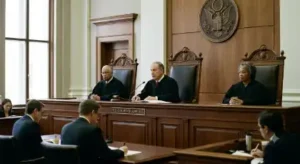
The judicial system has signaled strong skepticism toward the constitutionality of these state-level restrictions. In the pivotal case challenging California’s identification mandates, the U.S. District Court for the Central District of California issued a preliminary injunction halting enforcement of the law against federal personnel. The court concluded that California had likely overstepped its constitutional boundaries by attempting to regulate federal operations directly.
On appeal, the Ninth Circuit Court of Appeals affirmed the lower court’s block on the law. The appellate panel clarified that while states possess broad police powers to protect public safety within their borders, those powers stop short of dictating the operational parameters of federal officers executing federal law. The court noted that allowing fifty individual states to establish a patchwork of conflicting uniform, identification, and concealment laws would fundamentally disrupt national security uniformity and create unconstitutional friction for federal operations.
The Ninth Circuit’s stance aligns closely with recent Supreme Court jurisprudence regarding immigration preemption, notably Arizona v. United States (2012), which reaffirmed that states cannot establish independent criminal penalties or operational hurdles that conflict with or disrupt federal immigration enforcement objectives.
Implications for the Future of Shared Sovereignty
The legal resolution of the “No Secret Police” battle will resonate far beyond the immediate context of ICE operations. If the Supreme Court ultimately reviews these statutes, the final ruling will clarify the contemporary boundaries of intergovernmental immunity in an era of intense political polarization between state capitals and Washington, D.C.
A total invalidation of state masking bans will reinforce the absolute supremacy of federal agency operations, ensuring that federal law enforcement preserves complete autonomy over its tactical choices, dress codes, and safety protocols. Conversely, if courts carve out narrow exceptions allowing states to enforce baseline identification standards under the umbrella of public safety and criminal impersonation prevention, it could open the door for states to impose further transparency mandates on other federal entities operating within their jurisdictions, including the FBI, DEA, and ATF.
For legal professionals, civil rights advocates, and federal law enforcement personnel, this battle highlights a critical, ongoing structural tension: balancing local demands for accountability and community safety against the federal government’s constitutional right to execute its laws without state interference.